What Are Visible Copies
📅 2026 Update: New Developments in Copyright Registration
Since the original article was published, there have been important updates in copyright registration that could impact artists and content creators. These changes include new group registration options and adjustments to existing processes. The earlier article continues further down the page, providing foundational information on visible copies and copyright law.
🖼️ Group Registration for Two-Dimensional Artwork (GR2D)
A significant change is the introduction of the Group Registration for Two-Dimensional Artwork (GR2D), announced on December 19, 2025. This option allows artists to register between two and twenty published two-dimensional artworks with a single filing fee. All works must be published within the same calendar year.
This application became available on February 17, 2026.
📰 Updates to News Website Registration (GRNW)
In May 2026, the U.S. Copyright Office proposed an amendment to the Group Registration of Updates to a News Website (GRNW). This amendment clarifies that a "news website" can include sites reporting on various subjects that frequently update content.
The final rule was published on August 13, 2026 and is effective immediately.
💲 Current Fees and Costs
As of 2026, the fees for copyright registration have been updated. The electronic filing fee for a single author and one work has been reduced to $45. Group registration costs are $85 for GR2D and $95 for GRNW.
For standard paper applications, the fee remains at $125.
⏳ Processing Times and Variability
Processing times for copyright registration applications vary based on factors such as the complexity of the claim and the number of applications received. As of April 1, 2026, the U.S. Copyright Office is actively processing applications in the order they were received, following delays during a lapse in appropriations in late 2025.
📌 Key Points to Remember
- 🖼️ GR2D allows group registration for two-dimensional artworks.
- 📰 The GRNW amendment clarifies the definition of a "news website."
- 💲 Current fees include $45 for electronic filings.
- ⏳ Processing times vary based on complexity and submission volume.
- 📅 All changes are effective immediately as of 2026.
💡 Tips for Navigating Copyright Registration
It is important to consult your attorney to review the details of your unique situation.
🔍 Understand Group Registration Options
If you create multiple artworks, consider using the GR2D option. This can save you time and money by allowing you to register several pieces at once rather than filing individually.
🏷️ Keep Your Work Published
To qualify for group registration under GR2D, ensure all artworks are published within the same year. This requirement is crucial for successful registration and protection of your rights.
📄 Use Online Registration
The electronic Copyright Office (eCO) is the preferred method for registering basic copyright claims. Using the online platform can speed up the registration process compared to paper forms.
💵 Budget for Fees
Be aware of the current fees when planning your registration. Electronic filings are cheaper, while standard paper applications are more expensive. This budget consideration is essential for artists and content creators.
📅 Stay Updated on Processing Times
Processing times can vary widely. Check the Copyright Office's FAQ for the most current information on how long you might wait for your application to be processed.
🏆 Services Ranked by User Reviews (2026)
This section provides a list of services that assist with copyright registration, ranked by user reviews. The order reflects Trustpilot data from October 2026. Ratings can change over time, and while they offer insight into customer satisfaction, unhappy customers often leave more reviews, which can skew perceptions.
🥇 1. LegalZoom
LegalZoom has been rated 4.6 stars. It is known for its business formation services and intellectual property registration. This platform can help users navigate the complexities of copyright law and registration.
However, some users report delays and communication issues, which are important to consider before choosing their services.
🆓 Free Resources
The U.S. Copyright Office offers several free resources. This includes circulars, FAQs, and toolkits to help users understand the registration process.
Additionally, the Copyright Public Records System (CPRS) allows access to copyright registration data.
🔎 What to Compare When Choosing a Service
- 🎨 Range of services offered, particularly in copyright registration.
- 💲 Total fees and any additional costs.
- ⏳ Average processing times for application submissions.
- 💬 User reviews and overall customer satisfaction.
- 📞 Availability of customer support and guidance.
❓ Frequently Asked Questions
❔ What is the GR2D registration option?
The GR2D registration allows artists to register between two and twenty published two-dimensional artworks under a single application, simplifying the process for multiple works.
📅 How can I ensure my work is eligible for registration?
To register a work, submit a completed application form, a nonreturnable copy, and pay the appropriate fee. Ensure your work is published to meet eligibility requirements.
🔄 What happens if I miss the preregistration deadline?
If you preregister a work, you must register it within one month after becoming aware of infringement. Failing to do so may jeopardize your ability to take legal action.
📈 How long does it take to process a registration application?
Processing times vary based on claim complexity and volume of applications. It is best to check the Copyright Office’s FAQ for the latest updates on processing times.
🆓 Are there any free resources for copyright registration?
Yes, the U.S. Copyright Office offers several free resources, including toolkits and public access to copyright records, which can assist with understanding the registration process.
📑 Can I register a work created by someone else?
You can register a work created by someone else if you have the proper permissions or if the work is under a work-for-hire agreement. Ensure you follow the eligibility rules for registration.
⚖️ Recent Cases Related to Copyright Law
Recent court rulings have highlighted ongoing issues in copyright law, including interpretations of fair use and the implications of digital content sharing. These cases connect to the broader topic of copyright registration and protection.
- Court rules on licensing dispute involving Tri-County RespiteCommonwealth Court of Pennsylvania · August 3, 2026
- Court Reverses Trademark Ruling in Cheerleading DisputeCourt of Appeals for the Eleventh Circuit · June 24, 2026
- Alabama court rules on Trulieve cannabis licensing disputeCourt of Civil Appeals of Alabama · July 10, 2026
- Court rules on software copyright case against U.S. governmentCourt of Appeals for the Federal Circuit · July 16, 2026
For more information on recent rulings, browse more rulings on the news page.
End of October 2026 Update
When an author uses the copyright notice on his or her visual work, it does not need to be first submitted to the U.S. Copyright Office. Even so, in order to be valid, it must contain several required elements. First, the copyright symbol should be added to the beginning of the copyright notice.
The copyright symbol is an encircled "C" (©). A substitute of the copyright symbol is the word "Copyright" or the abbreviation "Copr.".
Next, the notice should contain the year of the work's first publication. If the work is a derivative or compilation, it may contain the year of the first derivative or compilation publication date. Finally, the copyright notice should have the name of the owner of the work or some kind of identification that can be recognized.
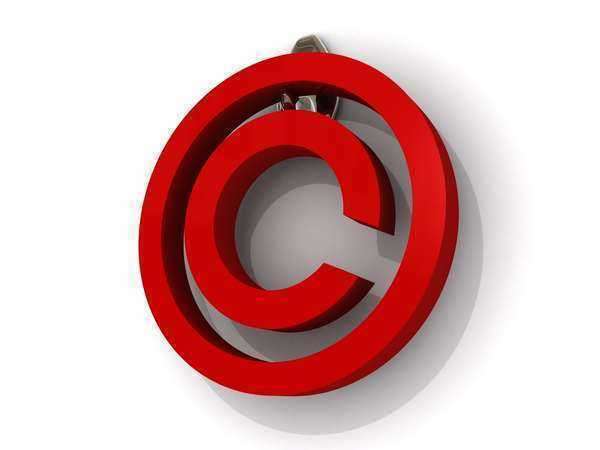
Example: © 2008 John Tavern
Since the copyright notice can only be seen and not heard, musicals and other audio-only works do not contain this type of copyright notice. As a result, the "C" in the circle cannot be used for anything other than visually perceptible copies of works. Audio works require other methods of copyright notice.